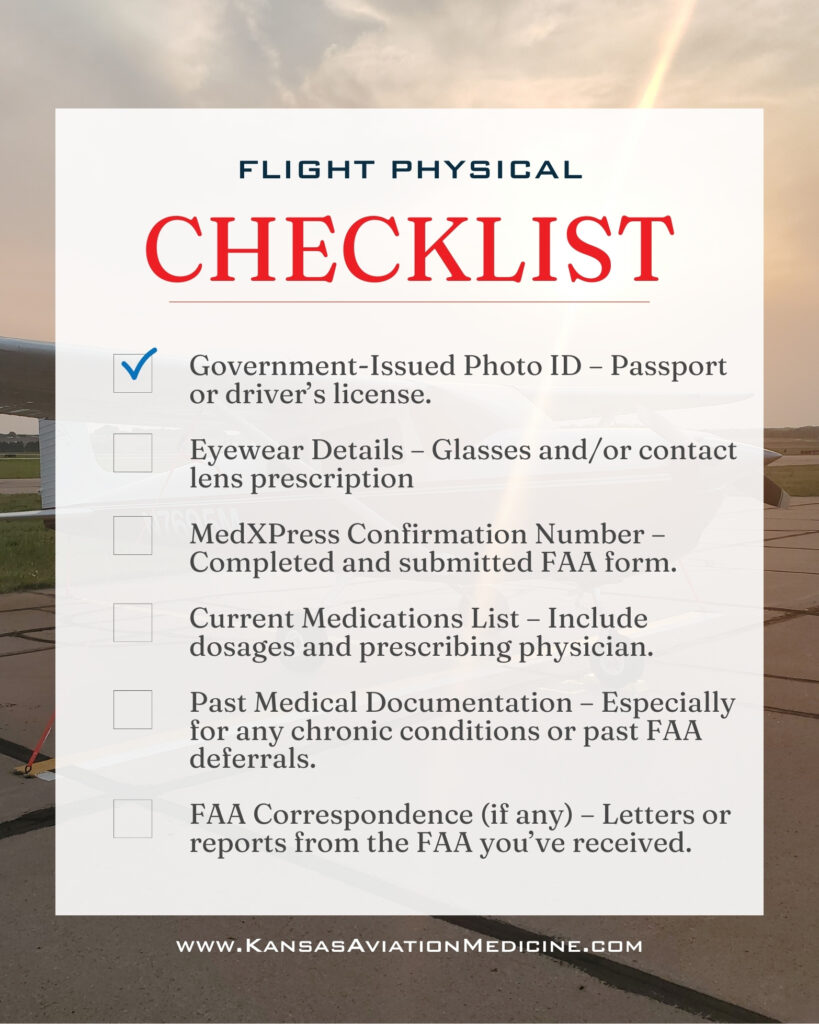
You wouldn’t show up to a checkride without pulling weather, reviewing the ACS, and running the numbers. Preflighting your FAA medical deserves the same discipline, and most pilots skip it entirely.
The majority of deferrals aren’t medical problems, they’re preparation problems. Wrong documentation, inconsistent MedXPress answers, a history item disclosed without the records to back it up. The FAA doesn’t give partial credit for showing up in good health. A clean, complete submission moves. An incomplete one sits.
Here’s how to get it right before you ever walk in the door.
Know Your Own File
Pull your MedXPress history and read it. Every application you’ve ever submitted is in the FAA’s system, and consistency matters. A condition you reported in 2019 that didn’t appear in 2023 will surface eventually, and you’ll need to explain the discrepancy. That’s an avoidable problem.
If you’ve had any correspondence from AMCD or a Regional Flight Surgeon since your last exam, bring it. Authorization letters, requests for information, special issuance conditions. Your AME needs the actual file, not your recollection of it.
Treat MedXPress Like the Legal Document It Is
Save a copy every time you submit and complete your exam within 60 days or start over.
Item 18 is where pilots most often get themselves into trouble. The question isn’t asking what’s currently affecting you. It’s asking about anything you’ve ever been diagnosed with, treated for, or seen a physician about. Pilots interpret it narrowly, the FAA interprets it broadly, and that gap is where omissions happen. Omission looks worse than disclosure. There is a right way to present almost any history item accurately, but you have to know what you’re doing before you fill out the form, not after.
Bring Documentation, Not a Diagnosis
The FAA wants to see stability, treatment history, follow-up, and risk profile. A diagnosis with no supporting records tells them nothing useful and often triggers a deferral while they wait for information you could have brought with you.
A solid packet for any known condition includes a concise treating physician summary, relevant test results with dates, your current medication list and dosing, and a clear statement of functional status. Specialist notes, imaging, labs. Whatever exists, bring it organized and labeled.
AMEs cannot hold an application more than 14 days waiting for records. The disposition tables the FAA uses to guide those decisions are built around complete, documented submissions, not partial ones. If you don’t have them at the exam, you’re getting deferred.
Get a Consultation Before You Schedule the Physical
If your history involves any of the following, do not just show up and see what happens: cardiac workups or procedures, sleep apnea, diabetes, psychiatric treatment or medication, a DUI or substance-related history, prior FAA correspondence, or anything you’ve never discussed with an AME before.
The exam room is not the place to work out your strategy. Once you’re in the chair with something disclosed on your MedXPress, the clock is running and your options narrow. A pre-exam consultation lets you decide in advance whether to proceed with a formal application, what to gather before you do, and how to present your history in a way that’s accurate and complete without creating unnecessary questions.
That one step keeps more pilots out of the deferral lane than anything else.
Pick the Right AME
This matters more than most pilots realize. An AME doing high volume with complex cases knows exactly what the disposition tables require for a given history and how to handle it at the exam. An AME who rarely sees complicated cases tends to defer conservatively on situations that don’t actually require it.
If your medical history is straightforward, it doesn’t matter much. If it isn’t, who you sit across from makes a real difference in what happens next.
The Short Version
Preflight the medical the same way you’d preflight the airplane. Know the conditions, bring what you need, don’t improvise. If your history is anything other than clean and simple, book a consultation first. It’s confidential, it protects your options, and it costs considerably less than managing a deferral after the fact. (Here’s what a deferral actually means and what to do if you get one.)
Kansas Aviation Medicine offers aeromedical consultations for pilots who want to get this right before the exam. Book here or call (785) 706-4327.